
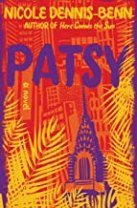
 Patsy is a single mother adrift in Jamaica in 1998. When she gets a visa to visit America, she grasps the opportunity to choose herself first, to pursue her dreams and aspirations. However this means abandoning her 5 year-old daughter Tru. Over the next decade, Patsy has to endure the scary realty of being an undocumented individual in Brooklyn. And finally, to paraphrase a statement in the recent Mr. Roger’s movie, it is often tremendously hard to forgive those who you love but have disappointed you. Excellent dramatic writing.
Category: Female author
The Great Alone – Kristen Hannah
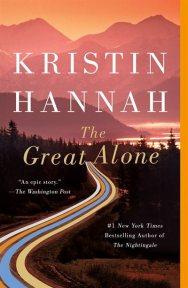 The most important character in this novel is Alaska: majestic beauty coupled with destructive danger. Be warned, Alaska can kill with brutal cold dark winters and savage wild animals. The key plot element in this book is the people that Alaska attracts: rugged individuals, survivalists and some crackpots. The Allbright family travels to Alaska in 1974, woefully unprepared for the harshness of life and survival. What follows is an angst-filed drama that sometimes can approach a soap opera story but the context of Alaska overcomes some plot issues.
The Immortalists – Chloe Benjamin
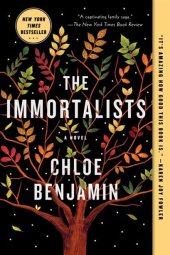 This intriguing novel begins in 1969 when four siblings (13, 11, 9 and 7 years-old) consult a psychic who allegedly tells them individually the day of their death. What follows is a narrative of each sibling that asks a series of questions. What is the nature of belief? Can fate be pre-ordained? What is the line between destiny and choice? Is there a link between reality and illusion? Is there real magic? At its core, this is a family love story even though the siblings appear to be remarkably different, creating complicated complex characters. This is very imaginative story-telling.
The Dutch House – Ann Patchett
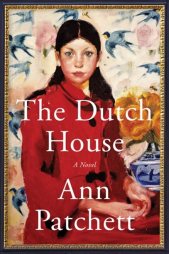 This is a deceptively simple and subtle book about family. The key characters are siblings, Danny and Maeve. There are some astonishing acts of cruelty in their early life but also acts of transcendent kindness. Danny is someone who lacks introspection – he commits to a task like learning chemistry with dogged determination; liking the subject is irrelevant. Unfortunately, he applies the same approach to his relationships, i.e. his wife, so love and happiness are non-factors in his relationships. His true happiness is only expressed to and with Maeve. Consequently, forgiveness is difficult for him, a fact that will complicate his life. Like most of Patchett’s writing, this is very fine story-telling.
Watching You Without Me – Lynn Coady
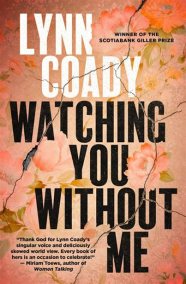 Karen, recently divorced, returns to her childhood home in Nova Scotia after her mother’s death, to care for her developmentally-disabled sister. Karen is understandably over-whelmed with grief and the difficult care of her sister. Thus she gratefully accepts extra assistance from Trevor, one of her sisters care-givers. So she is susceptible to manipulation and Trevor is a master manipulator. Accordingly, this is a masterful and entirely creepy character study of human frailty.
Daughter of Family G – Ami McKay
 Simply put, this is an amazing book. Ms. McKay is an excellent novelist (The Birth House, The Virgin Cure, Witches of New York). Her new book is a memoir with a unique context. Her great-great-aunt, Pauline Gross, confided to a pathology professor in 1895 that she expected to die young because she had observed a very strong family history of cancer. This statement led to a cancer genealogy study that ultimately resulted in the discovery of a gene mutation that creates a devastating cancer susceptibility, now known as Lynch Syndrome. Part of the book imagines the lives of Pauline and sister Tillie, the direct ancestor of Ms. McKay. Along this history, there are some dedicated physician-scientists but the ugly reality of eugenics is part of this quest. Much of the book is deeply personal since Ms. McKay also has the Lynch Syndrome mutation. What thought process informs the decision to undergo genetic screening? How does one live with this knowledge, with implications for your children (there is a 50% risk of transmitting the mutation)? And finally, there is Ami’s deeply moving and loving relationship with her mother so this is also a memoir of love and fate, tremendous family resilience, the link between the genes we inherit and the life we choose. This is a fantastic read.
Stranger Diaries – Ely Griffiths
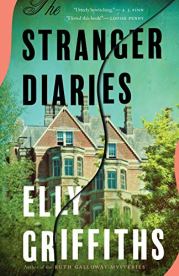 This is a very satisfying mystery/thriller. Who would have a motive to murder an English teacher at a high school in the south of England? And then kill another teacher? All the major characters in the story are women: a mother & daughter and the investigating detective who is a single gay woman of colour. The “bad guy” is, as typical in this genre, someone who no reader will ever anticipate, making for a fun read.
The Handmaid’s Tale – Margaret Atwood
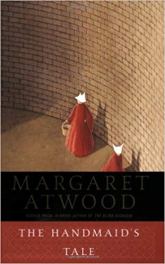 I first read this amazing book about 30 years ago so a re-reading was in order as a prelude to her new book The Testaments. And simply put, the Handmaid’s Tale is a masterpiece. Atwood’s writing is perfect, a slow reveal of the horrors of the Gilead revolution: the rise of totalitarianism and religious fundamentalism, the loss of women’s rights and autonomy with rampant misogyny. Handmaids are possessed by men (Of Fred = Offred) as breeders and are not taught to read! It is chilling to realize that many of the regressive features of Gilead are happening now throughout the world. Atwood is a national treasure.
The Testaments – Margaret Atwood
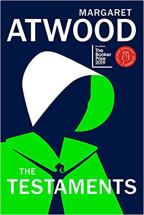 As a sequel to The Handmaid’s Tale, The Testaments is equally compelling but with a very different tone. Whereas The Handmaid’s Tale had a single narrator (Offred), The Testaments (set 16 years later) has three voices: two very different young women, one raised in Gilead and one raised outside, and the notorious Aunt Lydia. The resulting story is less introspective with more action, thus less reactive. The seeds of dissent are outlined clearly and logically with some Machiavellian motivations. This is a page turner, a completely engrossing read.
 What David Read