
 There are two key features in successful mystery thrillers: context and plot. In my opinion, context is often the most informative and dramatic element. This book is about two young women in two time-lines: THEN as high school students, and NOW, as post-doctoral researchers in a University medical research laboratory. Given my own background as a biomedical researcher, clearly the context is novel and appealing, the description of lab smells, the equipment, everything is described perfectly. But this is a book about relationships, in particular a friendship complicated by academic competition. And there are dark secrets: a key phrase repeated in the book is “You don’t have a self until you have a secret”. A key progression from dark secrets are lies and then paralyzing “Crime & Punishment” type guilt. Finally, this is a book about women. Highly recommended. Thanks, Karen, for this book suggestion.
Category: Female author
An Ocean of Minutes – Thea Lim
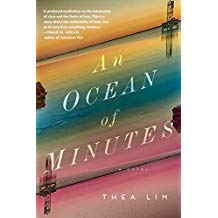 This Giller short-listed first novel is fabulous. The setting is 1980. To obtain medical treatment for her partner who has been stricken with a virulent flu, Polly agrees to time travel 12 years into the future to work for the TimeRaiser Corporation to rebuild America. So this is debt bondage, a form of indentured labour. The issue of time is considered in two ways: more time for her partner and time in the sense of memory. Will Polly be reunited with her partner Frank in 12 years, when he will have aged and she will not? The future is decidedly dystopian and so this book successfully melds several genres: what will you do to survive a pandemic, the dislocating effects of time travel forward and the return to your home, social issues of income inequality, the power of memory and the complexity of enduring love. This is just excellent story-telling.
The Lost Girls of Camp Forevermore – Kim Fu
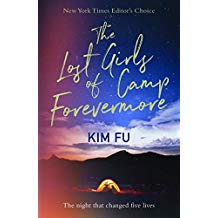 Previously, Ms. Fu wrote the very fine For Today I Am A Boy, and this new book is even better. Five young girls (ages 9-11) are stranded in the woods after an overnight kayaking trip, producing some “Lord Of The Flies” crises. This narrative is interspersed with the subsequent lives of the survivors: how are lives shaped by an early traumatic event? How are friendships tested by cruelties and betrayals? This is evocative writing and is highly recommended.
All Things Consoled – Elizabeth Hay
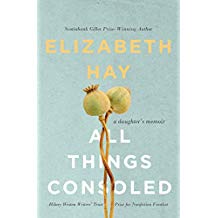 This book is subtitled “A Daughter’s Memoir”, and chronicles the last years of her parent’s lives after relocating from their home to London to a seniors residence in Ottawa. Ms. Hay’s wonderful prose describes her aged mother: “her loose skin hung off her like silken parchment … (her) bare arms were as pitiable as a ballerinas”. The decline in the health of her parents is described in depressing and brutally honest detail, proving once again that growing old is not for sissies. Ms. Hay’s relationships with her parents (and her siblings) is examined thoughtfully, carefully and critically, in particular her often fraught relationship with her tempestuous father. This is very fine writing, introspective and compelling.
Transcription – Kate Atkinson
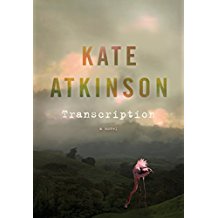 Ms. Atkinson has written an attractive spy thriller and mystery, set in 1940 and 1951. Given Atkinson’s past books, then it is no surprise that the story unfolds in a non-linear format. Juliet is recruited to MI5, and the resulting story is very English with regular tea providing comfort and solace to characters named Peregrine and Prendergast. Much like George Smiley in the legendary Le Carre novels, people in Atkinson’s story appear normal and ordinary, but nothing will be as it seems. This is a very entertaining book with some well-timed plot twists.
Lethal White – Robert Galbraith (pseudonym for JK Rowling)
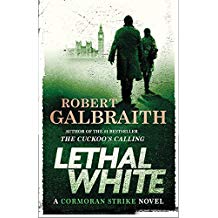 The fourth Cormoran Strike book has a complex plot and, as in previous books, the evolving relationship between Cormoran and his associate Robin is central to the story. In many ways, this is a superb procedural book: how are clues discovered and interpreted? The procedural emphasis is reminiscent of Michael Connelly’s detective Harry Bosch. But the real joy in this Galbraith book is how Cormoran and Robin interact, how ideas and theories are discussed and debated (much like Inspector Lynley and Havers in the E. George mysteries). Both characters are completely dissimilar and have some significant human frailties that are often endearing. Finally the choice of certain words requires the use of a dictionary, a delicious practise that I find completely satisfying. Violence is minimal; this is an excellent book about plot and motive.
Women Talking – Miriam Toews
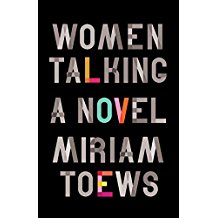 A fictionalized account of a true story, that women in a strict Mennonite community in Bolivia were repeatedly sexually assaulted while drugged, by men in their own community. The women are having introspective existential conversations: to stay (and fight) or leave? They also discuss moral issues of faith and forgiveness. The only periodic male point-of-view is the transcriptionist who is translating their conversations into English and who occasionally offers comment. The context is a conservative patriarchal society where women have no rights. They want safety for their children, the ability to practise their faith and to think for themselves. Powerful writing.
Stray City – Chelsey Johnson
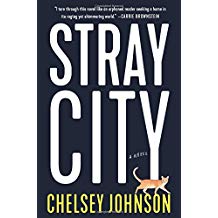 This book was a chance discovery at the library, so was read without expectations. Therefore the pleasure of reading a very fine first novel was palpable. Andrea leaves a strict childhood in Nebraska to be immersed in Portland’s lesbian life. A bad breakup results in a brief hookup with a man, and a pregnancy results. Much of the book details the difficulty of relationships, in particular the idealized fantasy of a relationship. There are funny parts and sad portions but the core of the book is about the family that we choose, for an excellent story.
The Good People – Hannah Kent
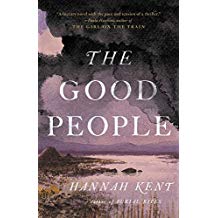 This is Ms. Kent’s second novel; her first was the excellent Burial Rites. Her two books have two characteristics: they are about women, and feature impeccable historical research. The Good People takes place in Ireland in 1825-26. The story is about the conflict between folklore and the emerging modern world of religion and law. The practice of folk knowledge to counter-act the actions of evil fairies leads to superstition, and gossip become malicious. All the characters are rich and compelling: an old crone, a grieving widow, a young maid, and an afflicted child thought to be a changeling. The story is both bleak and beautiful; highly recommended.
 What David Read