
The latest Harry Hole thriller is brilliant, one of his best. Hole’s usual chaotic life is even more nightmarish with binge drinking and blackouts. A fiendish villain plots to frame Hole for a murder that Harry can’t be sure that he isn’t guilty of. So a diabolical plot with Hole’s behaviour driven by revenge and some very dubious actions. Finally there is a very satisfying enigmatic ending. Overall, an outstanding example of Scandinavian noir crime thrillers.
 This is a very satisfying novel. First, the literary style is intriguing: long sentences with lots of commas and yet reading is smooth. Second, the subject matter is very topical; a dystopian future that begins in a localized fashion with two young lovers in an unspecified Middle Eastern location. Escalating conflict leads them to escape through doors that are portals to distant locations (London, Mykonos). Their future becomes uncertain in new lands that are overwhelmed by the arrival of increasing numbers of refugees/migrants like themselves. How do relationships survive when tested repeatedly – highly recommended.
 Labyrinth is the 4th and final book in the Cemetery of Forgotten Books series. Context (time and place) is an important feature of Ruiz’ books and this is especially true of Labyrinth: Barcelona is presented as an eerie Gothic wonderland and 1959 features nefarious political and criminal activities. (And at 800 pages, there is lots of space for context!). Labyrinth features the enigmatic Alicia Gris as an investigator tasked with a missing person case, leading to much intrigue as secrets are revealed. And there is some shocking violence. This is a haunting story – highly recommended.
 This impeccably researched biography of a scientific genius covers Darwin’s early life: his childhood, haphazard University education and then his 5-year voyage on the Beagle. Following his return to Britain, he then spent more than 20 years researching and publishing numerous scientific studies while marshalling his evidence for natural selection that would result in his publication of the Origin of Species. Darwin’s scientific life is impressive because of his breadth of interests and knowledge, from biology to geology, and his transition from observation as a naturalist to an experimentalist. Overall, an insightful description of a genius. Be warned, there is incredible detail, more than 500 pages plus footnotes and references. Browne’s second volume in the Darwin biography, The Power of Place, is equally detailed but less interesting without the Beagle adventures. Thanks, Mike, for this recommendation.
 In 2010, a very old woman, Vivian, receives a letter with a question: “If you now feel comfortable telling me what you were to my father?” Thus begins a long remembering of Vivian’s life, starting in New York as a 20-year old in 1940. Vivian is the epitome of white privilege, a delightfully hedonistic person with self-deprecating humour. The description of the NY theatre scene in the 40s is fabulous. Overall a recounting of both strong and toxic female relationships for a completely entertaining story. Thanks Amy.
 Full disclosure: I love Anne Tyler’s writing. In this slim novel, she continues her theme of writing about ordinary but quirky people in Baltimore. Micah is a 42-year old man who lives a predictable life, constrained by precise patterns of behaviour. “Sometimes when he was dealing with people he felt like he was operating one of those claw machines on a boardwalk, those shovel things where you tried to scoop up prizes but the controls were too unwieldy and you worked at too great a remove”. Can Micah find happiness? Tyler describes funny and poignant situations with introspective wisdom.
 This is the first book of White’s magnificent 4-book collection entitled the Once And Future King, an epic retelling of King Arthur legends. In this first book, the young Arthur (nicknamed Wart) is tutored by Merlyn so much magic is involved. Lessons frequently involve Wart’s transformation into different animals: fish, birds, a badger, etc. There are also some gut-busting hilarious illustrations of the difficulties of jousting. Imaginative writing is coupled with impressive knowledge of natural history (how to fly, how to swim) makes this an enchanting read.
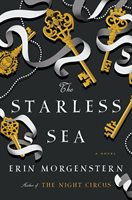 What if you found an old mis-shelved fiction book in a University Library that contains an incident from your own life, described in perfect detail? This is the beginning of this wildly inventive novel and it gets better! Doors are painted on surfaces that become portals to an underground maze of tunnels and rooms filled with books/stories. Characters in reality interact with characters from stories, and time is very flexible. But this magical place is under attack and great quests ensue. Morgenstern’s writing is wonderfully imaginative; previously she wrote the fabulous
  What David Read