
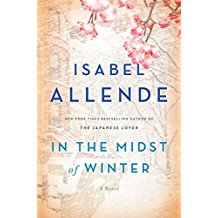
 A winter storm in New York brings together three distinctive characters: an American man nearly destroyed by grief and guilt; a Chilean woman survivor of the Allende aftermath in the 1970s; and a young undocumented woman from Guatemala. A fairly simplistic plot device allows the compelling back stories to emerge with Allende’s characteristic story-telling which is evocative. Each of the three characters has experienced tragic and sorrowful events, and yet there is hopefulness in a story contains unexpected romance and love. Allende is a treasure, and this novel is a very worthwhile read.
Anything Is Possible – Elizabeth Strout
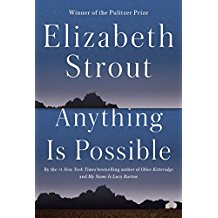
 Strout wrote the incomparable Olive Kitteridge (Pulitzer Prize) and the very fine My Name Is Lucy Barton. This new novel is set in a small town in Illinois, the actual home of Lucy Barton. A series of inter-connected stories have links to Lucy Barton, and Lucy actually visits her brother and sister in one chapter after years away. The stories centre on a series of confessional conversations and introspective remembrances that are compelling and captivating. There is an artful simplicity in Strout’s writing; a story about a B&B encounter is exquisite. Overall, this is a great read.
Next Year For Sure – Zoey Leigh Peterson
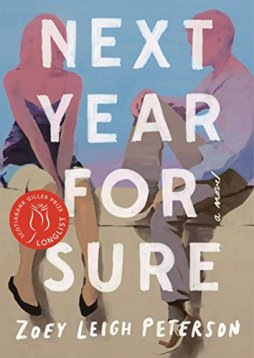 This is a fantastic book, a remarkable first novel that was long-listed for the Giller, and that, in my opinion, is much better than some of the books on the Giller short list. Full disclosure: this is a relationship book which everyone who reads this blog knows is my favourite topic. The story is about psychological intimacy, a couple that evolves to a consensual three-some and eventually to a four-some. The book is beautifully written with sub-headings like “Questions” and “Answers” and “What Kathryn Wants”. This is a delightful read about complex relationships with a brilliant ending – highly recommended, one of my best reads this year.
Manhattan Beach – Jennifer Egan
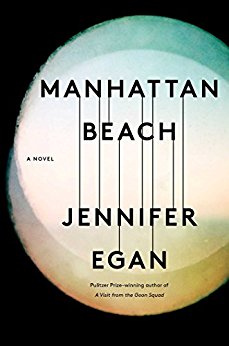 Egan won the Pulitzer Prize for her novel A Visit From The Goon Squad, and this new historical novel is a gem. Set in the depression-era 30s in New York and then in the naval shipyards in Brooklyn during World War II, the details of place and context are impeccable. The human relationships are a rich blend of secrets, lies and desertion, of love and lust. The writing is dramatic – part of the book describes so clearly the claustrophobic and oppressive world of diving which is also liberating. But it is the complex human dynamics the drive the story, with a very satisfying ending. This is a must-read book, in my opinion.
Bellvue Square – Michael Redhill
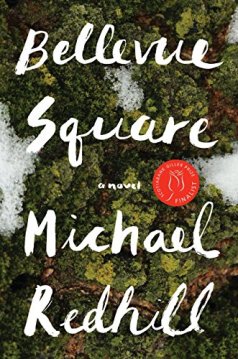 This is an imaginative book set in and around Toronto’s Kensington Market. The core of the book examines an existential question: is a doppelgänger real or a figment of imagination? How can a hallucinatory state be distinguished from reality? Redhill has written a darkly comedic and thoughtful book that justifiably has been placed on the Giller short list.
The Ninth Hour – Alice McDermott
 McDermott is a superb writer, Anne Tyler-like in her precise descriptions of place and emotions. In this new novel, the place is Catholic Brooklyn in the early part of the 20th century, specifically the tenements. Key characters are the Sisters who visit and minister to the poor, elderly and sick, a vocation that is implicit in their Order’s name, the Little Sisters of the Sick Poor. There are two mortal sins that dominate the lives of Annie, a single mother, and her daughter Sally. The first mortal sin is the suicide of the husband/father: ..”he stepped off this grey life – collar and yoke – not for lack of love, but for the utter inability to go on, to climb, once again, out of the depths of a cold February day, a dark and weary afternoon”. Sally performs what she perceives as an act of penance to mitigate a second mortal sin committed by her mother. The actions of the Sisters, the context of working in a laundry with sighs, sounds and smells – everything is described perfectly. Overall, an introspective intelligent book about the limits of love and sacrifice. Also recommended is McDermott’s previous book, After This.
The Burning Girl – Claire Messud
 Messud wrote the very excellent The Woman Upstairs, about the relationships of a mature woman. In this new novel, Messud has turned her perceptive gaze to a coming-of-age story of two girls, best friends since nursery school whose lives begin to diverge in middle school. What does friendship entail? What stories do we create for others and for ourselves? This is a beautifully poignant book.
Homegoing – Yaa Gyasi
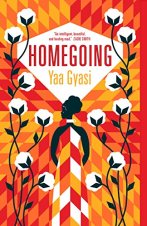 Two parallel lineage stories of two African half-sisters (who never meet). One storyline is Ghana, the other a slave story that leads to America. There is impressive historical detail, especially when describing the Ghana experience of collusion in the trafficking of slaves. The book is Michener-like in using storylines of successive generations, and yes, there is a useful family tree included in the text.
The Underground Railroad – Colson Whitehead
 A powerful book about the cruelty of American slavery. The horrible physical abuses are terrible to read, but the psychological abuses are equally horrific. The White belief tin the inherent savagery of African slaves led to eugenics experiments. A slave catcher who refers to his quarry as “it” rather than “s/he”. This is a disturbing but important book to read.
 What David Read