

Ms. Chevalier writes superb historical fiction featuring strong female characters (e.g., Remarkable Creatures). In her new book, it is 1932 and 38-year-old Violet is one of the “surplus women” left unmarried or widowed by World War I. She finds purpose by moving to Winchester to learn needle point to create kneelers for the cathedral. And there is impeccable information on bell ringing. Sometimes a sentimental story is just what is needed.
Category: Book themes
Find You First – Linwood Barclay

Miles Cookson is a tech billionaire who at age 42 receives the devastating diagnosis of Huntington’s Disease. This prompts a search for 9 children he “fathered” as a sperm donor 20 years previously. But these potential heirs are disappearing without a trace! This is vintage Barclay with impossible-to-predict plot twists: very entertaining.
The Forgotten Daughter – Joanna Goodman

Ms. Goodman wrote the excellent The Home For Unwanted Girls about the Duplessis Orphans, created when Quebec re-classified orphans as being mentally deficient in order to transfer their care to mental hospitals. Her new book continues Elodie’s story to achieve justice and an official apology. The time is the early 90s with the backdrop of separation and the 1995 referendum, with two fascinating characters, James and Vero, on opposite sides of the separation debate. Anger is a powerful force in people’s actions. And the difficulty of acting on principles is a dominant theme. Highly recommended.
Long Bright River – Liz Moore
Mickey is a patrol officer with the Philadelphia Police Department. Her routine patrol activities include searching for her sister Kacey, an addict and sex worker who is missing. And there is a serial killer preying on young women. Overall a gritty relationship story: there are no completely good guys. Mickey in particular is deeply flawed and makes bad decisions. The plot is seductively delicious with a lot of misdirection. Thanks Amy, for this recommendation.
We Ride Upon Sticks – Quan Barry

It is 1989, and a high school field hockey team (10 females, 1 male) in Danvers Massachusetts is driven to win the state championship. Can witchcraft help in this quest, particularly since Danvers is near to Salem, the site of the witch trials and burnings in 1692? This is a brilliant depiction of friendship in the context of high school and team sports. Teenage culture in 1989 is presented perfectly; music, hormones – sex drugs and rock-n-roll. Great fun.
A Town Called Solace – Mary Lawson
Clara, age 7, lives in Northern Ontario. It is 1972 and Clara has two responsibilities: to keep vigil for her runaway 16-year-old sister and to look after the cat in her neighbour’s house while Mrs. Orchard is in hospital. But then a strange man occupies Mrs. Orchard’s house! Three distinct storylines emerge, each with differing timelines, But this is Clara’s story: fear, love, resilience, a child’s imagination when truth is withheld. Lawson is a literary master; her previous book Crow Lake is equally compelling.
Klara and the Sun – Kazuo Ishiguro
Ishiguro has been recognized as a great writer by receiving the Nobel Prize for literature. This new book is simply brilliant, in part because of a unique point-of-view. The narrator Klara is an Artificial Friend (AF, aka robot), with acute powers of observing and learning. She is acquired by Josie and must learn about friendship and the nuances of human behaviour: love, loneliness, sacrifice, what it means to be human. Klara is an AF/AI with empathy, to serve as a companion, to prevent Josie’s loneliness. Empathy is not achieved by programming but rather by machine learning. Overall, this is a compelling story about relationships; Klara has a special relationship with the sun (she is solar powered) which she logically tries to apply to humans. And typically (recall Never Let Me Go), Ishiguro introduces a single word in the text that is not explained for 200 pages, creating a mystery. Fantastic book, highly recommended. Finally, this is a very nice companion book to Machines Like Us by Ian McEwan.
The Kingdom – Jo Nesbo
Nesbo is best known for his Scandinavian-noir crime novels featuring Detective Harry Hole. His new book also concerns crime in Norway but from the point-of-view of the perpetrators. Roy and Carl are brothers living on a mountain top. Roy works in a service station and as the elder brother, he functions as Carl’s keeper, first as children and now as adults. Nesbo’s stories typically address issues like morality, but this book is particularly philosophical. Motives for bad behaviour are explored, casual violence leads to murder. Acceptance of violence is a seemingly casual action. Untypically, romantic relationships occur, and the L-word (love) is used. And complex relationships are complicated by lies, deceit and willful ignorance of certain realities. Simply put, this is one of Nesbo’s best books.
Seven – Farzana Doctor
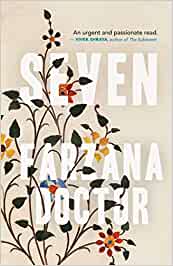
Sharifa is an Indian American woman living in New York. She accompanies her husband and 7-year-old daughter to India for an 8-month visit to Mumbai. In India, she researches the life of her great-great-grandfather, but increasingly becomes involved in a movement to ban female genital mutilation (khatna) in her Muslim religious community. This is a very strong story of kinship and community, and the damage to women’s bodies in the name of religion.
 What David Read