
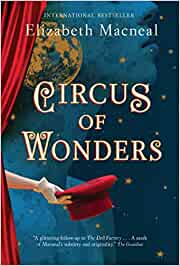
In Victorian England, the circus featured “human curiosities”, aka the freak show. The “performers” are exploited and objectified but also experience fame as someone no longer relegated to the shadows. There is also an interesting back-story of the Crimean War. A richly detailed historical novel, an enthralling slice of Victoriana.
Category: Female author
The Good Women of Safe Harbor – Bobbi French
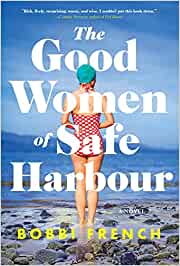
There is much to admire in this first novel. First, it is a female relationship book that deals with gritty subjects: teenage pregnancy, suicide, and medically assisted death. And second, the setting is Newfoundland. Some core values: friendship and forgiveness, the decision to love and be loved.
The Personal Librarian – Marie Bennett and Victoria Christopher Murray
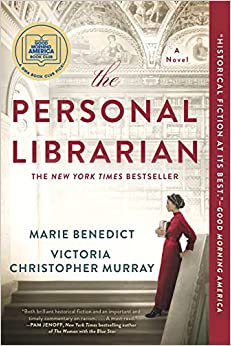
This is a fascinating fictionalized story of a real woman, Belle da Costa Greene, who in 1906 became the personal librarian to J. P. Morgan as he built the Pierpoint Morgan Library in New York city. Her expanding role in acquiring rare books, manuscripts and artwork is astonishing. But her prowess came at a deep personal cost; as a light-skinned African American woman, she had to masquerade as a white woman for her entire life. An insightful look at identity and legacy in America.
The Dictionary of Lost Words – Pip Williams
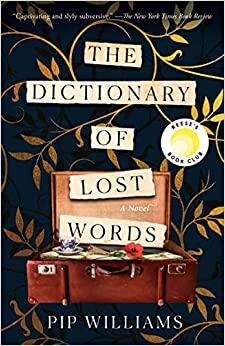
Full Disclosure: this fabulous book is about two of my favourite things; words and Oxford. The story covers the more than 40-year feat to assemble the Oxford English Dictionary (1886-1928). Words selected for dictionary entry are given context, mainly by white Victorian men. Esme is first brought to the Scriptorium as a young child by her widowed father, a lexicographer. She begins to collect “women’s words”, first those discarded by the male lexicographers and later from conversations with women. And this awareness of the importance of the context for words is influenced by the suffragette movement. A great story – highly recommended but be prepared for some very sad moments.
All Adults Here – Emma Straub

This charming book is about complex family relationships – the good, bad and ugly. Astrid has three children and three grandchildren, and lives in the Hudson Valley in New York state. Astrid is somewhat closed and flinty: “She believed pets were useful only in teaching young children about death. She knew this was an unpopular opinion”. This multi-generational story is about delayed adolescence with some persistent poor decision making, but also about love and resilience. Finally, there are some inspired comic situations – highly recommended.
The Department of Rare Books and Special Collections – Eva Jurczyk
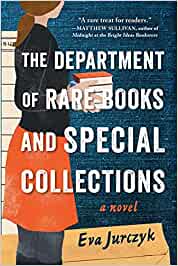
A rare book collection at a University Library become a vehicle for prestige, resulting in cut-throat politics in academia. And when a rare book goes missing, the plot thickens to become an intriguing mystery. The politics of gender, academic rivalries, suspicions, and the uncomfortable relationship with donors are all described perfectly.
The Last Chance Library – Freya Sampson
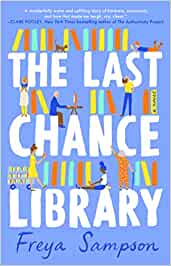
Full disclosure: I read any book with “Library” in the title. This book is an unabashedly sentimental and schmaltzy story about a campaign to prevent the closure of a small-town library in England. There is an emphasis on books and literacy, but also on the role of a library as a community location. The plot has many predictable tropes but still …. this is a book for library lovers.
Matrix – Lauren Groff
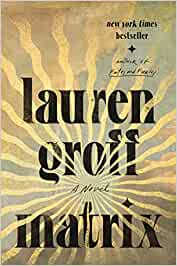
In the late 12th century, Marie is banished to an English abbey by Eleanor of Aquitaine. Under her leadership, first as prioress and eventually as abbess, the abbey prospers because of Marie’s ambition, pride and yes, arrogance. This is a feminist story, of female creativity, religious ecstasy, and passion.
Em – Kim Thuy
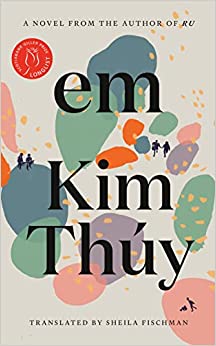
Ms. Thuy writes impeccable books that are short, like her titles (Ru, Vi), and yet packed with insightful content. This new book begins in Viet Nam in the 1970s, with the My Lai massacre and the fall of Saigon. Both the horrors of war and the resilience of survivors are highlighted: overall, this is a powerful book.
 What David Read