
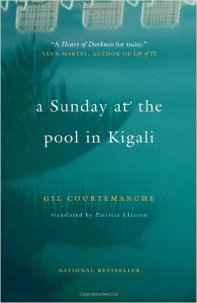
 Full disclosure – this is a disturbing book and not for the faint-hearted. The book details the events in early 1994 in Rwanda: the AIDS epidemic and mainly the Hutu-led genocide against the Tutsis. Amidst much death and brutal violence is a love story, the tender relationship between a Canadian journalist and a Rwandan woman who is Hutu but looks like a Tutsi. Issues of identity are crucial in the genocidal purge of “cockroaches”, the term the Hutu use to describe Tutsis to justify their extermination. Indifference from the UN and Western powers is described in detail, along with rampant corruption. This is a powerful book: how can love exist in this Rwandan hell?
American Gods – Neil Gaiman
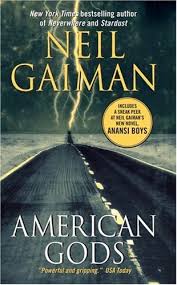 American Gods – Neil Gaiman (the author’s preferred text). This is a fascinating book about America, an imaginative fantasy with old gods and new gods and their conflict. How can you not love a book with a central character named Shadow? Gaiman’s writing reminded me of Stephen King’s The Stand (this is meant to be a compliment). Gaiman readily acknowledges that reaction to this book has been mixed: some readers love the book and some hate it! Mark me down in the “loved the book” camp.
A Good Death – Gil Courtemanche
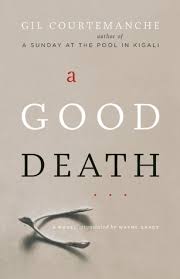 A Good Death – Gil Courtemanche (perhaps best known for A Sunday At The Pool In Kigali). This is a very well-written story of a dysfunctional large family in Montreal. The patriarch has always been a mean—spirited nasty individual who now has had a stroke with the onset of Parkinson’s. Some members of his family speculate that everyone would be better off if he died. The question of how his death might be facilitated becomes an important theme. His eldest son states that “you can only kill individuals that you love or hate. In this case, the son has never loved his irascible father but can’t hate him because of his illness. This dilemma is resolved in an interesting ending.
The Things They Carried – Tim O’Brien
 A tough war story about soldiers in Viet Nam. A chapter about the author’s reaction to being drafted is brilliant. A central theme is keeping the dead “alive” with dreams and stories. Powerful storytelling (this book came from a “50 books that everyone must read” list).
Frog Music – Emma Donoghue
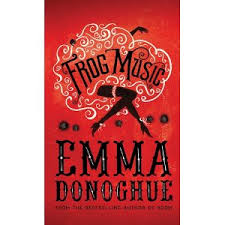 This is a very different book from Room. Frog music is set in 1896 San Francisco, a time of small pox and rampant racism towards Chinese immigrants. There are two compelling women characters: Blanche is a dancer/prostitute and Jenny is a cross-dressing free spirit. Essentially, the book is a murder mystery and is very entertaining.
The Beekeeper’s Pupil – Sara George
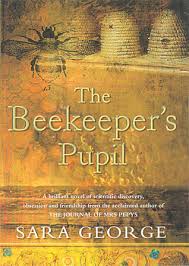 This is a story of two men: one is blind but has “vision”, to study the biology of bees; the other has sight, his manservant/assistant. The context is fascinating, an estate outside Geneva in the 1780-90s. So, like Darwin, the book describes painstaking research undertaken by amateurs. Experiments proceed by careful observation, by trial-and-error, but there is no documentation of course. Their bee research has another context, the French Revolution. This is a very fine book. (thanks Erin).
The Wondrous Woo – Carrianne KY Leung
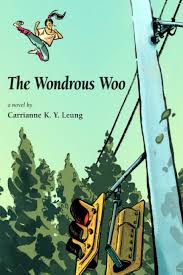 This is a really excellent coming-of-age story of a Chinese-Canadian family in the late 1980s-early 90s. It is essentially a story of sibling relationships with strong emotions like alienation and grief with some magic was well. An intriguing story line: after the death of their father, two of the children acquire special gifts/abilities, but the third sibling does not. This “magic” is accepted without explanation or even much discussion: it is what it is, and this is very satisfying to the reader. (thanks Steph, for this recommendation).
Nobody Is Ever Missing – Catherine Lacey
 A brilliant story about a 28 year-old woman who flees her husband and her NY life, to go to New Zealand. She continues to be lost. The writing is amazing, long disjointed sentences to mirror her aimless thoughts. And the ending is intriguing.
https://www.goodreads.com/book/show/18490560-nobody-is-ever-missing
The Immortal Life of Henrietta Lacks – Rebecca Skloot
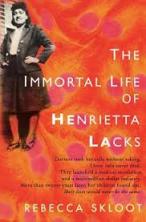 Henrietta is a black woman who develops cervical cancer in 1951. Without her knowledge or consent, some cancerous tissue is removed during radium treatments of her cancer, and this tissue become the first immortal cell line (cells maintained in culture forever). The cells were named HeLa cells after the first two letters of her first and last name. The book meticulously details the subsequent exploitation of Henrietta and her family, at a time when the ethics of human experimentation was not considered. An excellent historical story of exploitation and racism.
 What David Read