
 Simply put, this is a brilliant book, one of Atwood’s best. Three women (Tony, Charis and Roz) are each linked to Zenia, a brilliant and beautiful woman who is manipulative and ruthless. Over three decades, Zenia exerts considerable damage by creating really toxic relationships, but all three women remain in thrall, under a spell, beguiled. Even though Zenia’s lies and cons become obvious she somehow retains their sympathy while betraying their trust and treating male partners as loot. Fantastic story-telling.
Category: Female author
Cat’s Eye – Margaret Atwood
 Elaine, a middle-aged painter who lives in Vancouver, returns to Toronto (where she grew up) for a retrospective show of her paintings. This causes her to reminisce about her life. The entire book is great but for me, the first 1/3 is perfect. Atwood wonderfully captures the relationships between 8- to 10-year-olds, alternating between friendships and toxic competitions. School with corporal punishments and skipping grades, shopping and shoplifting things at Woolworths. And how children acquire (mis)information in an era when parental communication was non-existent. Another gem.
Lady Oracle – Margaret Atwood
 This is another literary prize book with some inspired comic events like joining Brownies as a child. The core of the story is about split identities; Joan was fat as a child and then transforms Ito a slim attractive version of herself. Jean also writes “Costume Gothic” books (aka Harlequin Romances) under a pseudonym. Many examples of this writing are included: Redmond is described as having rapacious lips, thinks that “he’d become tired of the extravagance of his wife Felicia: of her figure that spread like crabgrass, her hair that spread like fire, her mind that spread like pubic lice”! Wow. In contrast to this florid prose, Atwood’s classic phrasings like “the joy of self-righteous recrimination” are a joy to read. Joan even acquires another identity as a serious author of poetry so her personality is split further. And there are ill-fated relationships with men and blackmail. This book is a delightful pleasure to read.
Little Women – Louisa M. Alcott
 Everyone seems to e familiar with the March sisters from multiple movies and TV series, but I had never read the original novel published in 1909. Part 1 was read from an old book inscribed as being the “Property of Maisie Bentley 1913”, purchased in Bristol I think. Part of the charm in reading this very old book was inclusion of 8 full-page colour illustrations. Part 2 was read as a library e-book. Alcott’s writing is necessarily old-fashioned with emphasis on morals and some authorial homilies. These characters are so indelible and well-loved that it was a treat to read the original words.
Songs For The End Of The World – Saleema Nawaz
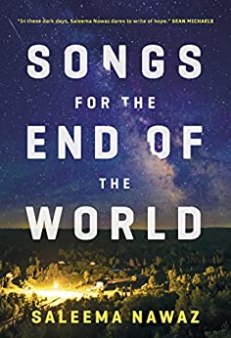 Previously Ms. Nawaz wrote the very fine Bread And Bone.This new novel, researched and written between 2013-2019, is uncannily about a novel coronavirus pandemic, so eerily relevant to today’s world. The storyline involves multiple characters with interacting stories; the pandemic timeline (August-December 2020) is supplemented with some backstory chapters. The key feature is the focus on how humans cope with a pandemic crisis. An attractive aspect of the writing is that it is philosophical rather than sensational. There are graphic descriptions of the worst of times: disintegration of civil society, the irrationality of scapegoating, racial profiling, the exacerbation of co-existing problems like economic inequalities. But there is also the best of times: life goes on, people exhibit resilience. The writing is exceptional, Atwood-like in quality of describing mood when the black cloud of a pandemic lurks everywhere. Highly recommended, especially when we are experiencing our own pandemic crisis. Sarah, thanks for advising me that the e-book was available for purchase now; the paper book will be published in August.
The Gilded Cage – Camilla Lackberg
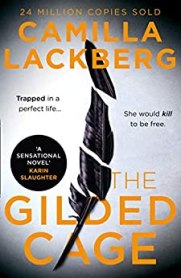 Faye is a trophy wife living in a gilded cage in Stockholm. When her husband Jack discards her and humiliates her as part of a divorce after 10 years of marriage, Faye dedicates herself to revenge, to destroy Jack’s life. Her skills are a formidable intellects plus a bloody-minded willingness to use sex and violence as manipulative tools. Revenge is nothing other than problem solving after all. This is a provocative and contemporary betrayal and revenge novel in the #MeToo era. Lackberg is a master of Scandinavian psychological suspense thrillers.
Had It Coming – Robyn Doolittle
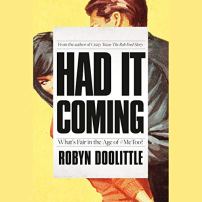 This book is a logical sequel to Ms. Doolittle’s book Unfounded about the complexities and difficulties concerning the prosecution of sexual assault cases. The subtitle of this new book is “What’s fair in the age of #MeToo?”. Is #MeToo a moment or a substantial movement? The narrative contains a thoughtful discussion of difficult topics: rape culture that enables sexual violence, rape myths and stereotypes, the paramount issue of consent, due process, power and privilege and even redemption. This is a thought-provoking book – highly recommended.
Surfacing – Margaret Atwood
 An early Atwood treasure from the 1970s with beautiful descriptive writing – this description off a restaurant meal is on page 1: “two restaurants which served identical grey hamburger steaks plastered with mud gravy and canned peas, watery and pallid as fish eyes, and french fries heavy with lard”. Is your mouth watering? The narrator is an un-named young woman who travels to a remote lake in Northern Quebec with three friends, to seek her missing father. There is an eerily effective transition to sinister happenings, but the true gem of the writing is the unfiltered dialog in the narrator’s head: this story is both spooky and brilliant, a must read.
The Dreamers – Karen Thompson Walker
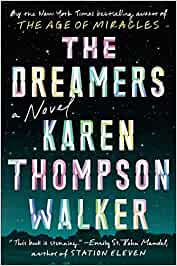 Given the current concern over a potential coronavirus pandemic, this remarkable book is prescient by capturing the mood perfectly of a contagion, specifically the chaos and confusion. In this story, individuals fall asleep and can’t be aroused; sleep is associated with a profound dream state and is fatal in many cases. This story is not about the medical/scientific search for the cause and cure; the focus is on residents caught in an eventual quarantine. Ms. Walker previously has captured the devastating consequences of an unexpected and unexplained catastrophe in her earlier (2012) book The Age of Miracles. A topical and riveting read.

