
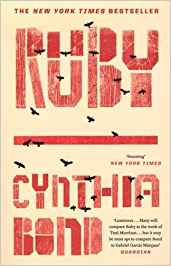
 This is a tough read because of disturbing content. Set in an all-Black community in East Texas in the 1950-70s, there is blatant racism, violence and tremendous cruelty. Well-written but be warned … This doesn’t sound like much of a recommendation but in this new era of increasing intolerance, it is worthwhile, I think, to try and learn from historical precedent and ask the question: are we really moving forward?
Category: Female author
The Conjoined – Jen Sookfong Lee
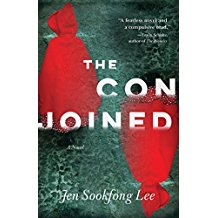 What if you are cleaning the basement of your family home after the death of your mother, and you find the bodies of two foster-children in a basement freezer who went missing 28 years ago? This is an intriguing book that examines family secrets and the social welfare system. Some of the ideas reminded me of Zoe Whitall’s book The Best Kind Of People where suspicion is directed to “good” people. What is the cost of bringing foster children into a home for all concerned? Highly recommended.
The Break – Katherine Vermette
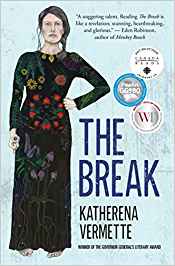 It is inexplicable to me that The Break was the first book eliminated from the Canada Reads 2017 competition. Admittedly this is a tough book to read, and the first in my experience that has on the cover page: “TRIGGER WARNING: This book is about recovering and healing from violence. Contains scenes of sexual and physical violence, and depictions of vicarious trauma”. This is a timely book about Indigenous women survivors, specifically 4 generations of women survivors who are flawed and damaged. This is a sisterhood book about resiliency – powerful storytelling but take the trigger warning seriously.
Wolf Winter; The Midnight Sun – Cecilia Ekback
I read these two books back-to-back so my comments will be combined. My friend Hilary introduced me to this author, described as a master of Nordic Noir. The best aspect of these two books is time and place. Both books are set in Northern Sweden where Norway and Finland converge. WW takes place in 1717; MS takes place in the same location 140 years later, in 1856. Living in this isolated setting is exacerbated by weather: bitter winter cold in WW and insomnia for one key character in MS due to continuous summer sunlight. In both books, murders are committed and solved by amateurs, the inhabitants (settlers) in WW or visitors in MS. The chief protagonist in WW is Maija, a woman with two children struggling to survive in the absence of her husband. Both books, but especially WW, have a mystical element (the old religion, aka witchcraft) from the wandering Lapp inhabitants of the region (now Sami). Both books are highly recommended.


Barkskins – Annie Proulx
 This is a sweeping Michener-like novel that spans over 300 years, with two family trees at the back of the book to keep track of multiple characters. The novel begins with two men from France who go to New France (Quebec) in 1693 to make a new life in the new world. Their lives diverge remarkably. Charles Duquet/Duke is driven by greed and opportunity to establish a huge and prosperous timber empire; Rene Set marries an indigenous woman so his story takes a very different path. Exploitation of forests is a major theme, not just in North America; the story also extends to China and New Zealand (the giant kauri trees). The book has a satisfying ecological message at the end – overall, a very good read.
The Island Of Books – Dominique Fortier
 Also from the CBC Books winter reading list: Most of this short but exquisite book takes place in the 15th century Mont Saint-Michel monastery: books and grief are the eternal themes, in the era of libraries as the keeper of knowledge just before the Gutenberg press invention.
Stag’s Leap – Sharon Olds
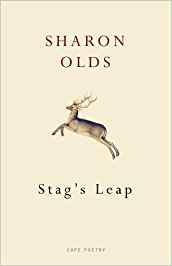 I read novels almost exclusively because generally short stories are too short for plot development and context (Alice Munro’s writing is an obvious exception). And because I read quickly, I typically do not read poetry where so much meaning is often attached to a single word. However, a fellow reader (Renee) who I respect greatly told me about Stag’s Leap, a Pulitzer Prize winner, and it is fantastic. The poems tell the story of the ending of the author’s 30-year marriage. The poem “Last Look” will take your breath away and probably make you cry. The poems are an insightful look at loss and resulting invisibility – remarkable emotional poetry.
Serial Monogamy – Kate Taylor
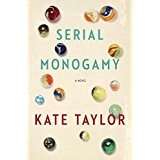 This is a new author for me, from the CBC Books winter reading list (thank goodness for CBC’s literary interest). This is an excellent book about relationships, my favourite topic. The central character is a wife/mother/author who writes a serialized fictional account of a long-standing affair that Charles Dickens had with Nellie, a young woman. This seems an unlikely focus for a novel but the writing is flawless with some time wrinkles that sometimes makes the reading complicated but very enjoyable.
The Little Red Chairs – Edna O’Brien

An astonishing book: the seduction by an evil person, the desperate lives of the displaced and dispossessed. The title refers to a 2012 commemoration of the siege of Sarajevo: 11,514 red chairs were placed in rows, one for each person killed in the siege that lasted for almost 4 years. What is remarkable about this book is that it is an Irish woman, Fidelma, who is the central core to the story which takes place in Ireland and England. Thanks Mike, for this recommendation.

