
 This is a short but meaningful book about two widowed people in their 70s who are willing to take a risk, to start a relationship based on gentle companionship. The storytelling has a wonderful authentic simplicity: “they ate a supper of macaroni and cheese casserole and iceberg lettuce with Thousand Island dressing and canned green beans and bread and butter and iced tea from an old heavy glass pitcher and there was Neapolitan ice cream for dessert”. They key feature in this book is the recognition that relationships, at any age, are complicated but especially for older people in the 70s and yet they have the courage to try, to see what happens.Thanks Karen, for this recommendation.
Category: Book themes
The Bookshop of the Broken Hearted – Robert Hillman
 Perhaps predictably, this library book was chosen from the new releases bookshelf entirely based on the brilliant title. The story takes place in rural Australia in the 1960s, with two vivid characters: Tom, a farmer, has been abandoned by his wife,
Rand Hannah, an Auschwitz survivor who has a dream of operating a bookshop in a small town. Theirs is an unlikely romance, a complicated relationship to be sure. The combination of complex issues in a wonderful setting is intoxicating.
The Two Of Us – Kathy Page
Last month I raved about Ms. Page’s novel Dear Evelyn. In contrast, this book is composed of very fine short stories. Many of you will know that I typically do not like short stories but Page’s writing makes each story a joy to read. There is impeccable detail when describing gardens, for example. But the best stories are about relationships. The tension in a meeting with a genetic counsellor is palpable and heart-breaking. Page is a literary treasure.
Priestdaddy – Patricia Lockwood
 The author leaves her Mid-Western home at age 19 to be married but after 12 years, financial constraints forces her and her husband to return to the parental home. This gives her the opportunity to remember an unconventional upbringing: a flamboyant and charismatic guitar-playing father usually (un)dressed in only his underwear, who, by the way, is a Catholic Priest with a wife and 5 children (how can that be, you may ask?); and a long-suffering over-protective mother. There are some eye-popping childhood experiences like attending an anti-abortion rally at a very young age. Ms. Lockwood also takes this opportunity for reflection, producing a memoir that is often comic but also poignant. And for a published poet, her writing is wonderful such as this description of a church space: “The ceiling is low and the lights flicker fluorescently and emit an insect whine. The whole place smells like where coffee goes to die”. Highly recommended; thanks to Sarah’s friend Elizabeth for this recommendation.
The Enchanted – Rene Denfeld
 This short book give a powerful and disturbing view of a prison in contemporary times. The two key external characters are unnamed: The Lady, a death penalty investigator hired by lawyers to evaluate evidence regarding death row prisoners; and the Fallen Priest. There is also a death row inmate, also unnamed until the final pages of the book, who watches and listens. And a prison society that is revealed as corrupt and deadly. So be warned, this is a tough read but memorable for good and bad reasons.
By Chance Alone – Max Eisen
 Canada Reads winner. This poignant and powerful memoir, written by an Auschwitz survivor, in presented in three parts. First, a happy childhood in Southern Czechoslovakia. Then second, at age 15, Max and his family are transported to Auschwitz-Birkenau in the spring of 1944; he is separated from his mother and three siblings instantly who are all killed. Initially Max and his father and uncle work as slave labourers but then are separated and his father and uncle are targeted for death. Max’s survival is by chance (hence the title). He is arbitrarily selected to work in the concentration camp infirmary; this provides a unique look at how this “hospital” worked while staffed by political prisoners. The third chapter is post-liberation which is fraught with problems leading to a complicated process as a young orphan to find his way to Canada. One striking feature of the Auschwitz story is that simple survival was the over-arching imperative so Max’s psychological and emotional response to the loss of his entire family had to be suppressed. The Canada Reads success was due to three factors. First the panel proponent, Ziya Tong, was well-organized and passionate. Second, the current emergence of white supremacy (e.g. New Zealand atrocity) in the world demands an understanding of the holocaust. And the third factor was sort of reverse ageism, that Max represents a disappearing generation of Auschwitz survivors and so it is important to give this book an audience.
Homes – Abu Bakr Al Rabeeah, with Winnie Yeung
 Canada Reads runner-up. Abu Bakr was born in Iraq. At the age of 9, his family relocates to Syria because of sectarian Sunni-Shia conflict, only to be swept into the Syrian civil war. The chapter headings are deceptively simple, unassuming and low-key: “May 2012: My First Massacre”. Finally, Abu Bakr’s family are accepted as refugees to Canada and so arrive in Edmonton in December 2014. Abu Baker speaks no English so his first school requirement to write a short story about his background is created by Google Translate. He then works with his ESL teacher Ms. Yeung to create this book. Thus, the literary style is basic but the simple stark prose lends itself to the telling of a profound story of survival and courage. The CR panel was influenced by the strong parental love element and the good news and hopeful ending.
Suzanne – Anais Barbeau-Lavalette (translated by Rhonda Mullins)
 Canada Reads contender. This is a beautifully written book, a fictionalized biography of the author’s grandmother who abandoned her young children to live a separate life. So the book is an attempt by the author to discover the story of her grandmother and in the process, the author achieves some understanding and respect for this mysterious part of her family history, the missing grandmother. It was a mistake, in my opinion, for some of the CR panel to dwell obsessively on why a young mother would abandon her children in 1952. Rather, the reader should accept that this was her choice for complicated and yes, inexplicable reasons; Suzanne never requested forgiveness yet the author (her granddaughter) does achieve some reconciliation from the reconstruction of Suzanne’s missing history. The writing is poetic, beautifully written in the second person. The story unfolds in non-linear tantalizing episodes, some detailed, some mysterious with gaps. This is a truly evocative read and highly recommended.
Brother – David Chariandy
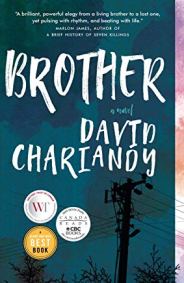 Canada Reads contender – previously described in January 2018. This wonderful book should have been the winner but once again, listeners to CR discussions must be mindful that winners are not due to literary merit because of the limitations inherent in the choice of the proponents. Canada Reads is interesting but still a reality TV show. Everyone should read Chariandy’s book.
 What David Read