
 This is a sweeping Michener-like novel that spans over 300 years, with two family trees at the back of the book to keep track of multiple characters. The novel begins with two men from France who go to New France (Quebec) in 1693 to make a new life in the new world. Their lives diverge remarkably. Charles Duquet/Duke is driven by greed and opportunity to establish a huge and prosperous timber empire; Rene Set marries an indigenous woman so his story takes a very different path. Exploitation of forests is a major theme, not just in North America; the story also extends to China and New Zealand (the giant kauri trees). The book has a satisfying ecological message at the end – overall, a very good read.
Category: Location / Setting
The Island Of Books – Dominique Fortier
 Also from the CBC Books winter reading list: Most of this short but exquisite book takes place in the 15th century Mont Saint-Michel monastery: books and grief are the eternal themes, in the era of libraries as the keeper of knowledge just before the Gutenberg press invention.
The Little Red Chairs – Edna O’Brien

An astonishing book: the seduction by an evil person, the desperate lives of the displaced and dispossessed. The title refers to a 2012 commemoration of the siege of Sarajevo: 11,514 red chairs were placed in rows, one for each person killed in the siege that lasted for almost 4 years. What is remarkable about this book is that it is an Irish woman, Fidelma, who is the central core to the story which takes place in Ireland and England. Thanks Mike, for this recommendation.
The Dry – Jane Harper
 A chance purchase in the Auckland Airport became a very satisfying mystery. An apparent murder-suicide is presented in the context of a small town in Australia 500 km north of Melbourne, with the added complexity of a cold case from the past. The context of how heat and continuing drought and mystery affects the psychology of a place and people both individually and collectively is presented very well – a very good read.
The Lonely Hearts Hotel – Heather O’Neill
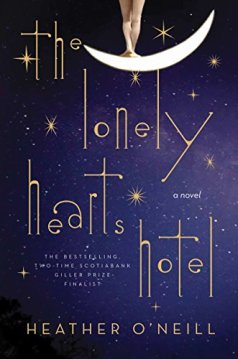 O’Neill is a wonderfully descriptive writer of places and people, with sensational metaphors. This new novel is about two orphans who endure terrible hardships while growing up in Montreal from 1915–25: poverty and abuse and then the depression. Much of the story is about vice (such a good word) in Montreal with an extension to New York in the 30s. The two principal characters, Pierrot and Rose, are both flawed and endearing, while dealing with fate and opportunity. This may be my favourite of all O’Neill’s novels.
The Luminaries – Eleanor Catton
 An epic story set in a remote gold mining frontier town in New Zealand’s South Island in 1866. There is a mystery with murder and disappearances; everyone is hiding misdeeds and withholding information. The structure of this Man Booker prize winning novel is fascinating. The first half of the book essentially describes a meeting of 13 men and each fairly long chapter provides a different point of view unique to each character. The second half has shorter chapters as more back story is revealed, mostly about some really delicious villains. This is fabulous story telling, even better as a second read compared to when I first read this book.
The Lola Quartet – Emily St. John Mandel
 The steamy heat of Florida is the setting in which people make bad decisions and lives spiral downwards: the consequences of lies and deception produce weariness and desperation. This is very good story telling by the author of Station Eleven.
Swing Time – Zadie Smith
 An un-named narrator tells a story that alternates between two times: childhood in NW London in the 1980s, and adulthood in the 2000s. All the important relationships in the narrator’s life are with women: her mother, her friend Tracey, and her employer Aimee, a Madonna-like rock star. A sub-plot in Africa is especially rewarding. Smith’s prose is insightful, she is an acute observer of the narrator’s world. This is sensational writing, the best of Smith’s books so far.
The Transcriptionist – Amy Rowland
 This book is a gem, a short but meaningful book about loss and finding one’s place in the world. First, it is a very New York book. But it is mostly an existential book. Lena is a transcriptionist at a prestigious newspaper; her job is to transcribe dictation, a job that is disappearing in 2001. Thus, Lena is looking for meaning in her life, a quest that is precipitated by chance encounter with someone on the subway. A very good read.
 What David Read